Just got back from a relaxing vacation and after a brief hiatus, it’s time to get back to business! As a person whose primary day-job involves sitting for long hours in front of a computer, I am always looking for ways to enforce proper posture while I sit. A good chair with adjustable lumbar (lower back) support is most often a given in modern offices and I am lucky enough to have the amazing Aeron chair which, I assume, is adjustable in 30 different ways including a setting that will allow me to work upside down! I am just kidding, of course, but the point is that a chair that offers you good support for your back is extremely important.
But the best chairs in the world will do you no good, if you continue to stoop or slouch while in a sitting position. Swiss Balls substituted as chairs can go a long way in helping you regain your posture. Based on your height, you choose the right sized ball and simply use that instead of a chair. But what do you do when you already have an office chair and rolling a Swiss Ball into office is not an option? Well, you can now use the next best thing: a FitBALL Seating Disc that sits right on your chair while still offering the benefits of a Swiss Ball.
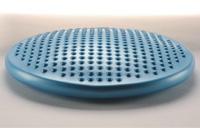 Disclosure: I was sent one (1) FitBALL Seating Disc directly from the manufacturer (Ball Dynamics) to try out and then present a product review on FitnessMantra. You can be assured that my reviews will always be unbiased, irrespective of whether I purchase the product or receive it to review.
Product: FitBALL Seating Disc
Manufacturer: Ball Dynamics International, LLC
Presentation: One 15-inch inflatable Seating Disc with an extra air-hole-plug and a plug-removing tool.
First Impressions
The Seating Disc has a strong rubbery texture and has the feel of a good quality product that should last for a long time. You don’t require a pump to inflate this disc and the air-hole plug does an excellent job of keeping the disc at the right inflation level even after extended periods of usage. When first inflated, the Seating Disc warped a little bit near the edges, but after a day’s use and adjusting the inflation level, these disappeared.
One sure sign you probably don’t have a good posture while sitting? It hurts when you sit right! And this is exactly what I felt within 10 minutes of using the Seating Disc. It’s amazing how much my lower back started to resist my sitting on the Disc although it might be true that continuing to use this product will eventually resolve that issue. It takes a few attempts to get the inflation level just right for you. It’s probably not a good idea to over-inflate the Disc to avoid extreme instability while seated. At the same time, under-inflating the Disc will make it too stable and chair-like and so won’t really enforce a change in your posture.
How the Seating Disc Is Supposed To Help You
So how does this thing work and why is it supposed to be good for your (lower) back? The key is a word I have been using many time in the past few sentences: stability (or rather “instability”). Every small (mostly unnoticeable) movement that you make to stabilize yourself on this Disc while sitting utilizes the smaller muscles around your lower core (abdomen) and lumbar region. The eventual strengthening of these muscles is supposed to go a long way in alleviating the lower-back pains most commonly associated with extended periods of sitting. Also, by enforcing a good posture, you will most likely gradually learn to sit erect and keep your lower back curved inwards which is the right way to sit.
Working On The Ball
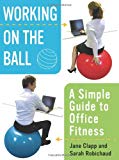 Along with the Seating Disc, I also received the book “Working On The Ball” by Jane Clapp and Sarah Robichaud - a guide to achieving fitness in the office by working on a Swiss Ball. The book describes various little exercises you can perform on a Ball while using it as a chair in the workplace. Granted, most of these exercises will make you look and feel a little silly, but they are supposed to help you get through the day without that nagging pain in your lower-back by evening. Since most of the exercises described in this book deal with a Stability Ball, only a few of them could be adapted to work on a Seating Disc.
Prolonged Use And Discomfort
While the initial effects of enforcing posture are all well and good, prolonged use is an altogether different story. I personally had to get off the Disc after about 15-20 minutes because of soreness I felt in my lower-back. While I am sure this may have something to do with my incorrect posture before using the Disc and it’s possible that extended use may very well reduce this soreness, I would like to hear from other users of Discs or Swiss Balls as chairs. If you use such devices for sitting the whole day, do comment on whether you had any discomfort during the early days of usage. For now, I plan to use for about half-an-hour at a time - once in the morning and once in the afternoon.
Science Behind The Seating Disc
Finally, I would just like to mention a couple of points from a scientific perspective. I tried to look up research concerning the usage of Swiss Balls as chair-replacements and while most do not disapprove of their usage, the results as far as benefits go have been quite inconclusive. For example, a study titled “Stability ball versus office chair: comparison of muscle activation and lumbar spine posture during prolonged sitting” finds that although there is a slight increase in muscular activity, there is increased discomfort as well, causing the study’s authors to come to the following conclusion: “The small changes in biological responses when sitting on a stability ball as compared with an office chair, combined with the increased reported discomfort while on the ball, suggests its use for prolonged sitting may not be advantageous”.
Another study, “Sitting on a chair or an exercise ball: various perspectives to guide decision making“, tried to discern the cause of possible discomfort: “Sitting on a ball appears to spread out the contact area possibly resulting in uncomfortable soft tissue compression perhaps explaining the reported discomfort.” and concluded that “The results of this study suggest that prolonged sitting on a dynamic, unstable seat surface does not significantly affect the magnitudes of muscle activation”
Conclusions
So it certainly looks like the jury is out on the real benefits of using Stability Balls or Seating Discs. But one thing to keep in mind is that if the discomfort is only caused because we have been sitting with a wrong posture until now and are trying to correct that, extended usage might indeed help fix the problem. I would welcome comments from users who have tried such devices for longer periods and have experiences (either positive or negative) to share. As for the answer to the question “Is the Seating Disc right for me?”, well, you’ll never know until you try one for yourself, will you?!

{ 1 comment… read it below or add one }
I considered sitting on a swiss ball while working in the office but it seems the experts actually discourage doing it except for a short period of time (e.g. 40 minutes). I’ve never heard about the Seating Disc, I might try it out if I ever have lower back trouble again (which I no doubt will)!