Do you remember the very first post on Fitness Mantra? (Probably not, because this blog was just 1 day old and I was the only reader!) It was posted on May 4th, 2006 and was called “Break That Fast” . In that post I extolled the virtues of a good, healthful, well-rounded breakfast so one could begin the day with a revved up metabolism and take care of one’s essential nutrient-requirements early on.
Well, imagine my consternation, when I read an article last week in the L A Times that basically said it was all hype! Titled “The Breakfast Hype” (update: only the abstract is now available for free), the article begins with “Be it eggs or a hearty bowl of oatmeal, morning fare has long been branded the most important meal. Now some scientists are saying: Not so.”
Great! So this entire blog was built on shaky ground. Maybe it’s time to pack up and say good bye and thank you for all your support these last 5 months.
Then again, maybe not.
Have you read the entire article? If not then go ahead - at least skim the main points - I’ll be right here waiting for you. The first thing I noticed was this: for an article that claims to debunk the breakfast “myth”, it spends a great deal of time praising a good and healthful breakfast! Specifically it raises these excellent points:
Why breakfast is good for you:
- Most nutritionists and health experts maintain that this is unwise. Breakfast skippers, they say, risk skimping on important nutrients.
- They also tend to binge later on, actually increasing their risk of gaining weight.
- “Currently, Americans, on average, fall short on their daily servings of whole grains, fruits and dairy foods. Eating breakfast is an excellent way to add these foods to the diet.”
- In the morning, blood glucose level is generally low. “Since the brain’s primary source of fuel is glucose,” Bowerman (a registered dietician) says, “it seems logical that fueling up in the morning … would make sense.”
- “Many of the foods that people consume at breakfast are things they may not consume the rest of the day,” such as dairy products, fruits and whole grains. Foods generally served at breakfast are good sources of calcium (from milk, yogurt and cheese), fibers (from whole fruits, whole wheat bread and cereal), iron (from fortified breakfast cereals or whole grain breads), and vitamin C or A (from orange juice and fortified milk, respectively). “If you skip that meal, you will make up for those calories later in the day,” Salge Blake says. “But are you going to be reaching for high fiber cereal or nonfat milk that’s rich in vitamin D and calcium? Probably not.”
The article continues to raise many more valid points about the importance of breakfast including statisitics that show breakfast skipping for losing weight almost always backfires leading to weight gain in the long run. Another 1998 study of 504 young adults in Bogalusa, La., reported that breakfast skippers were less likely to meet two-thirds of the recommended dietary intake for many vitamins and minerals, including vitamins D and C, and calcium.
The biggest noted problem is that people who skip breakfast try to make up the deficit at work where limited choices lead to the consumption of energy dense foods rather than nutrient dense ones with good calorific payload.
And breakfast fuels the brain, helping it perform better, says David Benton, a professor in the department of psychology at Swansea University in Wales. In a 1998 study of 137 women and 47 men, Benton found that students who routinely skipped breakfast (including on the morning of a test) recalled fewer words than people who had had breakfast. Their performance improved when they were given a glucose drink.
The unclear link between breakfast and obesity:
So what is the problem? Well, according to the article, the link between breakfast and obesity is not clear. Apparently studies on a group obese women who were on a reduced calorie diet did not prove any difference between one group that skipped breakfast and the other that didn’t.
Another Wesleyan University study initially found that breakfast eaters had lower Body Mass Index compared to skippers, but this difference vanished when other factors like energy intake and physical activity were considered. My reaction to this is maybe the energy and activity in the breakfast eaters came as a result of the breakfast itself - it could be the breakfast that enables the fitter students to be more physically active in the first place - a twisted case of cause and effect! Give the inactive students some breakfast and watch them get active, I say!
Should you skip breakfast?
Some researchers certainly seem to think so. David Levitsky, professor of nutrition and psychology at Cornell University thinks that dieters who drop breakfast are on the right track.
In a still unpublished study, he had undergraduate students eat well-defined meals under controlled conditions — including an all-you-can-eat breakfast some days and no breakfast on others. Both groups could eat as much as they wanted for the rest of the day.
The skippers, Levitsky found, ate about 150 more calories at lunch — but no extra calories for the rest of the day. As a result, they ate 450 fewer calories. “If you skip breakfast twice a week, that’s about 1000 calories less,” Levitsky says — enough, over time, to make a significant difference in one’s weight.
A professor even tried a test on himself. He noted a phenomenon called “anticipatory activity” whereby he would wake up several hours before breakfast in anticipation of the meal and skipping breakfast enabled him to sleep better. This really surprises me because I have been having a good breakfast all my life and have never woken up before the alarm goes off!
Why I eat breakfast (and you should too):
Let’s face the facts: Some people just think of breakfast differently than others. Consider Denny’s Lumberjack Slam:
Compare the nutrition values in this meal as reported by Chowbaby to the Recommended Dietary Allowance (RDA) values:
Calories: 1128 (more than 50% RDA)
Total Fat: 68 grams (more than 100% RDA)
Saturated Fat: 20 grams (100% RDA))
Cholesterol: 573 milligrams (almost twice the RDA)
Sodium: 3852 milligrams (about 1.5 times RDA)
If you begin your day with this, you had better be a real lumberjack spending a good part of your day chopping trees by hand and transporting them (and even then you could do with a little less fat injection that early in the morning)! Otherwise, if you are like most people leading more and more sedentary lives with desk jobs, you are probably better off skipping this kind of an artery-shocking breakfast.
A healthful breakfast, on the other hand is typically composed of whole grains, dairy and fruit to give you the energy, proteins and vitamins needed to get your day off to a great start. The Baltimore City Department has a quick card to help you make good choices (click to see the entire image):
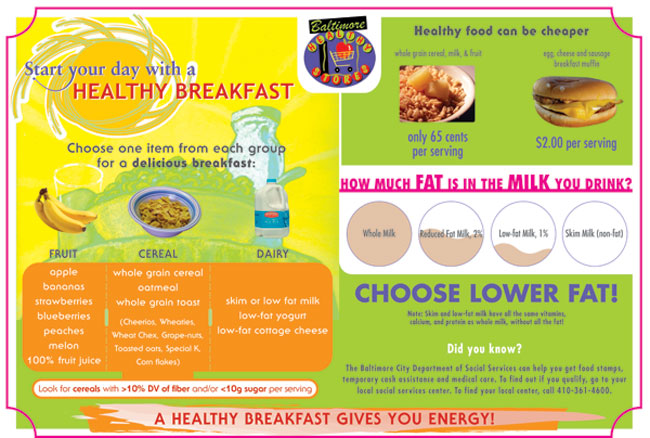
Other choices, of course, include eggs and the occasional lean-meat breakfasts. People who are lactose intolerant could try soy alternatives to fulfill protein requirements, but just folowing this simple cheatsheet andmaking one choice from each group each morning will provide the best combination of nutrients.
I find that eating breakfast helps me feel energized and full until my mid-morning snack. It also reduces my cravings for unhealthful foods and helps me focus in the mornings. I would never consider skipping breakfast because I know that it is a great opportunity for me to get some whole grain and dairy.
Do leave a comment to let me know what your own experiences have been with breakfast. Have you considered skipping it (or already do so?) and if so what effect did it have on your day?
In my opinion, as long as your breakfast is within calorie limits (typically 400-500) and is composed of healthful ingredients, I see no reason to skip it, especially since it provides your body with essential nutrients you might not get during the rest of your day.
[tags]nutrition, breakfast[/tags]
{ 3 comments… read them below or add one }
I lost 25 pounds six years ago, and have kept it off, by skipping breakfast and lunch. I just make sure I eat nutritious fare at dinner. Even Ruth Striegel-Moore, who conducted the study at Weslyan, admits that “we still need more research,” because there have not been full-scale clinical trials.
Meanwhile, I’m sticking with what works for me. For someone to scold me would be like for a person to admonish the late-departed Sir Edmund Hillary: “Well, what do YOU know about mountain-climbing?”
I totally agree with you about eating a healthful breakfast.I got into the habit of eating breakfast only a week ago and have already lost 5lbs!I feel so amazing in the morning after I have a good breakfast.I have so much energy till my first break.And,I eat alot less calories throughout the day and at night.I also think that the other important equation in this formula is to drink plenty of water all day long.Your body can’t distinguish weither you are thirsty or hungry,so I drink some water before I decide to eat and it usually satisfies me.So,you are very smart in your thinking about breakfast.I hope everyone reads your blog and follows it.
Seejaye,
How much did you weigh? I’d say that if you are over weight, it is a given for you to lose weight if you didn’t eat breakfast.