It Was An Itsy Bitsy Teenie Weenie Yellow Polka Dot Fallacy
25
May
… that you heard for the first time today!
At the outset let me begin by saying that if you ever hear someone tell you “Eat This To Lose Weight”, then you should ask that person to wait for a minute while you replace your regular ears with a pair of “skeptic” ones! Note that the operative word in “Eat This To Lose Weight” is “To” which implies that eating that particular food by itself can cause you to lose weight.
Here’s something that is so painfully obvious that it hurts me to even write it: If you put something in your mouth other than air or water and swallow it, it will (repeat: will) add to your weight. Obviously at the end of the day if you have eaten a total number of calories that is less than what you have expended (by exercising, walking around, doing your chores and even just plain breathing) then you would have lost weight compared to what you weighed yesterday; but the first statement still stands: food itself will (always) add to your weight.
OK, now that I have that out of my system, let’s get onto the topic at hand! Last week saw the announcement from the Federal Trade Commission (FTC), which also oversees product advertising, that ads suggesting eating dairy will make a person lose weight are finally coming to an end. The FTC said that although it did not actually enforce this, the dairy industry behind the ads finally gave in to a group of doctors called the Physicians Committee for Responsible Medicine (disclaimer: this purportedly vegan group promotes the absolute abolishment of animal based foods) who claimed that such a cause-and-effect relationship simply did not exist.
The two marketing campaigns at issue involve the “Milk your diet. Lose Weight!” ads on television, Internet and in magazines, and the “3-A-Day. Burn More Fat, Lose Weight” ads, which are now mostly Web-based.
- Lose the ads, not the weight, say doctors
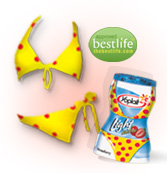 Now when Yoplait features a plump girl lose weight by simply gobbling down loads of yogurt with the song “It Was An Itsy Bitsy Teenie Weenie Yellow Polka Dot Bikini” playing in the background, you just have to know there’s something wrong with this message. Heck, they even built a website around this fallacy!
Granted, the site has the mandatory “As Part Of A Regimen Of Exercise And A Low Calorie Diet” (or some similar phrase) tagged on to the bottom, but who reads disclaimers anyway? All viewers see is someone losing weight as they eat something sweet. And they think: Sweet!
And so I am sure we have hordes of people at home wasting away on their couches, gulping down yogurt and wondering when they need to weigh themselves again so they can see the pounds drop off. Well, here’s some news folks, it ain’t happening. You eating, you gaining. You use more energy than you take in, you losing. Simple.
This site itself has twice before commented on the benefits of milk, but in both cases I have always been particularly wary of calling milk a “weight-loss food” (there’s no such thing). Got Milk is my first post on the topic of dairy and although I have mentioned studies that show calcium plays a part in preventing the body from easily storing food as fat, nowhere will you see outlandish claims that milk will actually help you lose weight. Infact, I said (and i quote):
Believe you me: It is; but don’t get me wrong: If you really drink milk all day (especially the “whole” kind), you will not only not lose weight but add some artery-clogging saturated fat in the process.
In the very next paragraph I mention the milk study that only shows that adding calcium to an already planned-out calorie-restricted diet helped in reducing fat stored - but there’s obviously no way the calcium (or the dairy products themselves) can cause weight loss.
Even when I gave you “5 Reasons You Should Drink A Glass Of Milk Before Bedtime” not one of the reasons was anywhere close to “Milk will help you lose weight!”.
What can we learn from all of this?
- If it sounds too good to be true it probably is (the only itsy bitsy bikinis I see these days are on lifeless store mannequins - and I know they don’t eat a lot of yogurt)
- Just because you discovered people were attributing outlandish magical powers to good foods does not mean you should stop eating those foods in protest. Remember, dairy products (especially the low-fat and fat-free varieties) are still excellent sources of whey protein and function as good snack fillers (in lieu of other fatty snacks).
- Keeping the attributes “moderation” and “common sense” uppermost in our minds will enable us to see through the hype on either side of this issue (No, Yoplait - we are not going to believe that eating your yogurt alone will help women get into itsy-bitsy bikinis - not until your ad shows that woman burning some calories as well! And No to you too Physicians Committee for Responsible Medicine - granted milk may not have weight-loss powers, but that does not mean you ask people to become vegan!)
Let’s hope we are all granted the wisdom to understand the motives behind the actions and comments of others and, more importantly, figure out for ourselves what is best for our bodies and ourselves.
Technorati Tags: health, fitness, nutrition, dairy, milk, yogurt, yoplait
Related Posts:




1. Infared Sauna Kid | May 27th, 2007 at 5:53 am
what if the food you put in your mouth causes the body to consume more calories breaking it down than the food provides? Celery i think is one.
2. fitnessmantra | May 27th, 2007 at 2:40 pm
Hi Sauna Kid,
I was almost waiting for someone to say this about celery (or diet coke like I have heard elsewhere!) and you have! Yes, celery might just actually qualify as a “food” that needs more calories (during digestion) to metabolize than it provides in the first place (this is because although celery does have energy, it is mostly cellulose, which is not usable by the human body).
But if you do a little more research you will realise a few things:
1. Yet as enticing as all this sounds, the dietary bankroll built by this approach would be very small, probably amounting to no more than a few dozen calories a day.
2. There have been those who have taken this tiny sliver of truth and used it to form the basis of what they tout as “negative calorie diets,” proving once again that anything can form the core of a diet plan someone wants to sell to others, provided it contains a notion that so much as vaguely sounds like it might work and weds it to the promise of easy, quick, effortless, and pain-free weight loss.
But further down the article is some good news too:
But in defense of celery, we note that even if it doesn’t contribute mightily to a caloric imbalance which serves to work waistline magic, those who are eating it aren’t eating something else. Sometimes the key to a successful reducing plan is not so much the ingestion of “good” foods as it is the avoidance of “bad” ones. And it’s hard to sneak a chocolate bar into a mouth that’s busy chewing celery.
So don’t worry so much about negative calories and trying to “lose weight by eating” - I can personally guarantee you that (alone) will not work.
In other words your jaw muscles should be the last ones you use for weight loss!
-FM