An August 2006 report titled “F as in Fat: How obesity policies are failing in America” (PDF) from the Trust For America’s Health shows that over the past year, adult obesity rates have increased in 31 states in the U.S. and stayed the same in the rest of the states. The worst affected are the states in the Southern belt - infact 9 out of the top 10 most obese states are from the South. Mississippi is ranked the heaviest with 29.5% of all adults being obese.
What is even more scary is that the percentage of adults who are “obese or overweight ” exceeds 60% in 28 states with MIssissippi once again taking the unenviable first place with 67.3% of all adults being either obese or overweight. Jackson, MS: we have a problem.
The report is based on an analysis of a state-by-state telephone survey conducted by the federal Centers for Disease Control in which 350,000 respondents were asked about their height, weight and other information. The survey’s margin of error was plus or minus less than three percentage points in every state.
-Via Washingtion Post
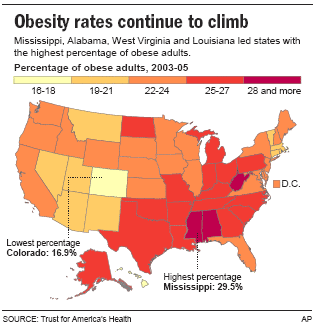 I don’t want to go over the risks that being obese (or even overweight!), puts you in because all of us are already aware of things like heart disease, cancer, diabetes and my top priority: (but often overlooked) increased costs in medical care and insurance. But I would like to take some time to understand the most glaring reasons for these results as I see them and look for ways to take on this epidemic (and it is one, if you haven’t realized it yet).
It is no surprise that Mississippi was ranked 50th in 2004 and 49th in 2005 on the basis of “per capita income” and the rest of the most obese states also fall into a similar pattern when it comes to socio-economic status. So nobody should be surprised to see Connecticut, Vermont, Rhode Island and Massachussetts in the top 6 healthiest states.
The bottom line is that obesity is generally higher in states with lower socioeconomic status (seven of the “fattest” states are also among the bottom 10 states in terms of per capita income.) The incidence of obesity is also higher in minorities.
-Via SciGuy
At first glance this would seem anomalous - in India for example, the poorest states have the highest cases of malnutrition and underweight people. We have all seen the unfortunate photos from places like Somalia and Sudan where scarcity of food leads to malnutrition. In the U.S. however the situation is vastly different. Food is no longer scarce or even expensive - well actually only the healthful food is expensive - and therein lies the answer.
It’s cheaper to eat unhealthy food
Take a look at McDonald’s USA Dollar Menu page. You can get any one of either a Double Cheeseburger, McChicken Sandwich, Fries, Soft Drink, Snack Size Fruit ‘n Yogurt Parfait, Hot Fudge Sundae or 2 pies and a Side Salad - for a dollar. Of these I guess the Side Salad is the healthiest (as long as you watch the dressing) (Someone even ate all of these in one sitting and lived to write about it!). A quick perusal of McDonald’s nutrition pages reveal that a double cheeseburger has 460 calories with 23 g of fat (11 g saturated and 1.5g trans fat) while a McChicken Sandwich has 370 calories with 16g of fat. (I think I need to run a couple of miles just for reading that, forget eating it!) But ask McDonalds for a salad as a meal and you are presented with a line of “Premium Salads” costing upwards of $5. My point is this: it’s always cheaper to eat unhealthy food!
Key points from the report:
While the entire document is well worth a read, fear not if you don’t have the time for 76 pages. Here are the key points summarized:
- Why obesity matters: Increases risks of diseasesand indirectly affects healthcare costs and reduces worker productivity
- No natonal policy on reducing obesity and promoting health inspite of known risks.
- Factors affecting fat: This is mentioned on page 5 (if you read only one page of the report read this one) and has a list of actionable items that communities and the government can address to reduce obesity. The most important items here are:
- Higher calorie intake (almost 300 more per day than in the 1980s)
- Portion distortion
- Value sizing - attaching importance to cost versus quality (”Can I supersize that?” or “Do you want the mega-jumbo size for only 50 cents more?”)
- Electronic culture - video games and TV leading to less activity
- Nutrition in schools - focus is on low cost rather than on nutrition
- Influx of sugary sodas in schools and the workplace
- Sedentary lifestyle at work - more and more desk-based jobs leads to less activity during the day.
- Cities and Suburbs more conducive to driving than walking or biking
- Lower income neighbourhoods have less access to affordable fresh fruits and vegetables leading them to consume more processed food.
- Advertising of unhealthy foods to children and prevalence of fad-diets.
- Key events in obesity - just describes various events in the history of the government’s efforts to combat obesity (from the creation of The President ’s Council on Physical Fitness in 1956) all the way to the release of the report on Food Marketing to Children in 2006)
- Changes in America’s eating habits - describes how more calories are being consumed, portions sizes have increased and milk consumption has decreased in favor of sodas and fruit drinks.
- Portion distorion - Another eye-opening page with comparisons of food portions 20 years back wth those today. For example Coffee with whole milk and sugar 20 years ago was 45 calories, while today’s Mocha with Steamed milk and Syrup is 350 calories - a difference of 305 calories!
- A Survery of Chronic Disease Directors - most of them believe funding and education are the key ways to combat obesity. The good news is they want to focus on workplace strategies.
- Intervention points to tackle the problem - ways to solve the problem include woking with families (reduce misconceptions, encourage good food choices at home) and tackling individual children (posters, flash card, music)
- The Alliance for a Healthier Generation releases guidelines for eliminating sugary drinks from schools (bottled water and 100% juice leads the way!)
- How Arkansas is leading the way in promoting the health of its children.
- Limiting of lawsuits related to obesity - stop blaming fast food companies for your own unhealthy choices!
- A list of recommendations - Finally, the report ends with some suggestions like the need to implement long term strategies, better measures of “success”, taking action now, educating children and adults alike and making healthy food more easily available and affordable.
My own personal belief is that fitness, like charity, begins right in your own home. Most of the information in the report can be thought to be a mere common sense approach to fighting obesity and increasing fitness and we can best ensure a more healthy community by planting the seeds of fitness in our own backyards. Look in your house for ways to help the cause and then work outwards.
Be healthy!
F as in Fat: How obesity policies are failing in America”
Technorati Tags: health, fitness, nutrition, obesity
Related Posts: