Zig-Zag Your Way To Weight Loss
08
September
You’ve heard that change is the only constant thing, but believe it or not, our body does not like change all that much! Unless we’re really overloading or undercutting calories, most of us (as you might have realized by now) might end up in a narrow weight-range during significant portions of our life. Arising more as a result of survival-instincts than anything else, our bodies have evolved to adapt to our surroundings and especially to our food intake.
In the Starvation Response, I wrote how our metabolism tends to adjust itself when it is confronted with sudden changes in calorie-intake. Take in too many calories and our metabolism speeds up to take on the excess (while it may not be enough to prevent fat storage, it is still likely to be a little higher than before). Conversely - and unfortunately for those of us trying to lose weight - take in too few calories, and after an initial period of weight loss, your metabolism will slow down to account for this decrease in input-energy and you will start to plateau.
What then is the solution to this? After all the one fundamental fitness truth is that to lose weight you have to consume fewer calories than you are burning up! Known by various names such as carbohydrate-cycling and high-low eating, a technique that has worked for many and that you could certainly try is …
Zig-Zag Dieting
What is zig-zag dieting? It is simply periods of low-calorie intake with a day (or two) of high-calorie-intake. It’s that simple. And powerful. In fact, zig-zagging is considered to be one of the best (and fastest) ways to lose weight without the Starvation Response setting in.
Mark two separate days of the week as your so-called cheat days. These are the days you will consume your regular (or slightly higher) number of calories for weight maintenance. Typical examples of these days could be say Wednesday and Sunday (note that they are at least 2-3 days apart). On the rest of the days bring down your calorie-intake to weight-loss levels (typically 300-400 calories below maintenance levels).
The whole idea behind zig-zagging is to never let your body realize that you are really going calorie-deficit in the long-run! By day three, if you had kept up your calorie-deficit instead of including a cheat-day, chances are your body might catch on to what you are trying to do and adjust its metabolism thereby thwarting your efforts. But by including a day of “regular eating” in between, you are throwing your body a curve-ball and confounding it into thinking things are back to normal - and then back you go on a calorie deficit for the next 2-3 days. (I am, of course, grossly oversimplifying a pretty complex process, but the gist is not much different from this).
The best graphical way to picturize this is to think of an electrocardiograph that you may have seen in hospitals. It is the chart that records a patients heart-beat on a graph:
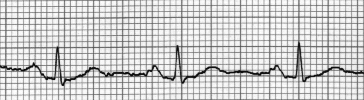
The spikes are your “cheat-days”, the days you trick your body into thinking things are normal by eating your regular foods and calories for weight-maintenance. The other “low-lying” regions represent the days you fall into calorie-deficit (say 300-400 fewer calories a day).
This technique has a much greater chance for success than simple, consistent calorie reduction alone and a beneficial side-effect of this method is that it takes away dieters’ extreme craving that you might experience since you always have a cheat day just around the corner to look forward to.
Why wait? Start zig-zagging your way to weight loss today!
Technorati Tags: health, fitness, diet, zig-zag diet, carbohydrate-cycling
Related Posts: