RSS Subscribe Subscriber count

Archived Posts from 'FitnessMantra News'

Foods Labeled “All Natural”: How natural are they?

13

December

npr logoDriving home from work yesterday while listening to my favorite show on the radio, NPR’s All Things Considered, I chanced upon a couple of interesting clips that explore the very common use of the word “Natural” in food packages and nutrition labels.

In the segment Meat Firms Give USDA an Earful on ‘Natural’ Label, Allison Aubrey mentions that:

The U.S. Department of Agriculture is considering a new definition of “natural foods,” at least when it comes to meat and poultry. At a public meeting, the agency heard from critics who say that for meat labels, a “natural” claim should only be allowed when meats don’t contain any additives or preservatives.

This is certainly good news for sticklers of natural food products who do not want any kind of preservatives in their meats. For example:

One common technique used by chicken processors is to inject the meat with saline solution. The additive itself is natural. But is it natural to pump it into chicken? Manufacturers like the Sanderson Farms Company, based in Laurel, Miss., and Hormel, makers of the Natural Choice line of deli meats, say it isn’t. And they want their products to stand apart from meats treated with salt or other materials.

When saline solution is injected into the meat, it tends to tenderize and flavor the meat, but also disturbs those who worry about misleading consumers. And thnk about this too: the salt water increases the weight of the chicken (which is usually sold by the pound) and so there’s the other concern that consumers are now paying partially for the weight of the injected salt-water while the label on the package continues to tout “All Natural”!

Some of this is human psychology. Agriculture Department officials noted Tuesday, for instance, that they need better information about what consumers think terms like “natural,” “minimal processing” and “artificial and synthetic” mean. This could shape what practices officials allow for each term.

Federal officials have convened a Dec. 12 public hearing at Agriculture Department headquarters in Washington. That four-hour hearing will just be the appetizer. Next, the Agriculture Department will start formally rewriting the rules.

-Via The Mercury News
What to EatThen there’s the non-meat side of the story. Think about the plethora of common household products like jams, cereal bars and sauces. Do they qualify as natural? NPR talks about that too.

The segment Looking Behind the ‘Natural’ Label on Foods is another thought-provoking discussion between Noah Adams and nutritionist Marion Nestle about what it really means when foods are labeled “natural.” Nestle is the Paulette Goddard Professor of Nutrition, Food Studies, and Public Health at New York University and author of a recent book What to Eat.

To find out for myself, I decided to see for myself what ingredients were used in a leading product that is labeled as being natural.

Nature Valley is one of the largest manufacturers of ready-to-eat bars including trail-mix and granola bars.
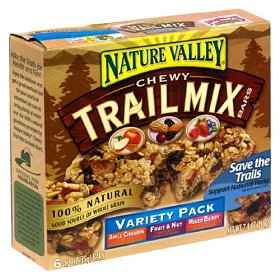
nature valley trail mix

Their Chewy Trail Mix product line consists of popular ready-to-eat bars that proudly bear the following sign on their packaging: “100% Natural, Good Source of Whole Grain”. That alone would be enough to convince most consumers that the bar is an excellent addition to their pantry.

But let’s take a good look at the ingredient list:
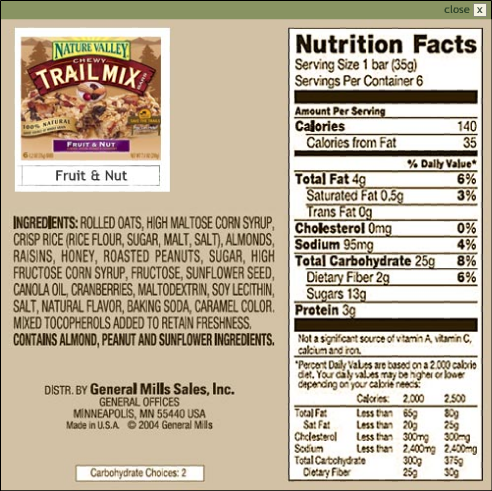
nature valley trail mix nutrition value

Two suspects pop right out fo the list: High Maltose Corn Syrup and our arch-nemesis High Fructose Corn Syrup. You already know that High Fructose Corn Syrup (HFCS) is made in industrial vats by running multiple genetically-modified enzymes over (almost always) genetically modified corn-starch, unnaturally extracting glucose and then increasing its fructose content to about 55%. High Maltose Corn Syrup is not too innocent either - it is just a distant cousin of HFCS except it has a higher maltose (rather than fructose) content and is not as sweet. It is still a corn-based, enzymatically produced, unnatural product.

Now enzymes are in use everyday in our body starting from the mouth and all the way down to our intestines - that is how we process food. But should enzymes be used to convert a naturally occuring whole-grain like corn into glucose (and then increasing either its fructose or maltose content) before we ever get a chance to consume it? Can it still be considered “natural” after all this processing? These are important questions the FDA should address so consumers are aware of what constitutes a natural product.

In contrast consider truly natural products like regular oatmeal or natural sweeteners like honey or pure maple syrup. These are almost “directly from nature” products and the only “processing” they undergo is literally chopping the product down to size (in the case of oatmeal) or pouring into convenient jars (for honey/mape syrup) for easy consumption.

The next time you walk into a grocery store and see the words “Natural” on a product, a simple quick peek at the ingredient list will reveal the truth to you. As a discerning consumer you owe this to yourself.

Technorati Tags: health, nutrition, food labels, natural, high fructose corn syrup

Related Posts:


del.icio.us Friday

08

December

Fitness Mantra del.icio.us pageHere’s another all new del.icio.us Friday. Stay updated with this news as it happens by subscribing separately to the Fitness Mantra del.icio.us feed.

Highlight of this week is a New York Times article that highlights a different take on being overweight or obese. Back in July I wrote about The cost and benefit of eating healthful foods in which I mentioned that eating well might cost a little more but it would be certainly worth it in the long run. This week’s article Extra Weight, Higher Costs show you in greater detail exactly why:

Heavy people do not spend more than normal-size people on food, but their life insurance premiums are two to four times as large. They can expect higher medical expenses, and they tend to make less money and accumulate less wealth in their shortened lifetimes. They can have a harder time being hired, and then a harder time winning plum assignments and promotions.

- Via Extra Weight, Higher Costs

Wow, you - and I - learn something new everyday, don’t we?

Now onto the health and fitness stories for this week:

  1. instructables : Homemade instant oatmeal: Instant oatmeal is great for a quick breakfast at the office. Not only is it easy to make your own, the homemade version is more filling and less expensive.
  2. High Protein Diets May Boost Cancer Risk: Eating a low-protein diet may protect against certain cancers, while a diet high in protein may increase the risk for malignancies, a new study suggests.
  3. Promoting Self-Weighing In Teens Is Not Helpful To Weight Management: Teenage girls who weigh themselves frequently are more likely to binge eat and participate in unhealthy weight control behaviors in the future, according to new research from the University of Minnesota School of Public Health.
  4. Got Lawsuit? Milk Dieter’s Is Thrown Out: Catherine Holmes saw the ads for the so-called “dairy diet” and thought it would be a tasty way to lose a few pounds. After all, she loves buttermilk, yogurt and cheese. Instead, the Arlington woman says, she gained three pounds on the diet, which dairy companies have spent hundreds of millions of dollars promoting. She sued the industry.
  5. Strap on an Apron, Eat Healthier: A new study shows that among young adults, the healthiest eaters are those who frequently prepare their meals at home.
  6. Youth to bear brunt of diabetes epidemic: More than 380 million people worldwide would be living with diabetes by the time today’s children reach their thirties and forties, if no action is taken to reverse current prevalence, medical experts have warned.
  7. Preparing Food Helps Young Adults Eat Better: Young adults who often purchase their own food and prepare meals at home eat fast food less often, eat more fruits and vegetables and have better overall diet quality than those who are not involved in planning and cooking their meals, according to researchers at the University of Minnesota.
  8. Obese should exercise not ‘diet’: A program which encouraged women not to diet but to take part in exercise classes found significant improvements in health and mental well-being.
  9. Onions and Garlic May Help Fight Cancer: Spicing up your diet with onions and garlic may help lower your risk of developing some cancers. This is according to the results of 8 studies conducted in Italy and Switzerland and is in line with some past research.
  10. Eating fruit and veg ‘halves miscarriage risk’: A study of thousands of pregnant women revealed those who included fruit and veg regularly in their diet were 46 per cent less likely to miscarry.
  11. Very slim women risk miscarriage: Very underweight women are 72 per cent more likely to suffer a miscarriage in the first three months of pregnancy.
  12. A tango could be what the doctor orders: The unfit, overweight and elderly will be told this week to take up the tango in the interests of their health.
  13. 10 Ways to Avoid Holiday Weight Gain: Enjoy the holiday spirit without wrecking havoc on your waistline. Wishing you a healthy and happy holiday!
  14. Fast Food Inside Hospitals Fuels Concern: Fast food restaurants set up inside many U.S. children’s hospitals increase patient consumption of unhealthy meals and give some people the mistaken notion that the food is healthier than it is, a new study finds.
  15. Many women may not recognize bulimia symptoms: n a study of 158 women with bulimia-type eating disorders, Australian researchers found that nearly half did not acknowledge a problem with their eating.
  16. Obesity ‘to fuel rise in cancers’: Soaring obesity levels could result in up to 12,000 cases of weight-related cancer being diagnosed annually in the UK by 2010, say experts.
  17. Extra Weight, Higher Costs: There is another consequence to packing on extra weight: being fat costs money — tens of thousands of dollars over a lifetime.
  18. Trans Fat Banned In N.Y. Eateries: The New York City Board of Health voted unanimously to require the city’s roughly 20,000 restaurants to stop cooking with trans fats, making New York the first major U.S. city to adopt such a ban.
  19. Pediatricians Blast Inappropriate Ads: Inappropriate advertising contributes to many kids’ ills, from obesity to anorexia, to drinking booze and having sex too soon, and Congress should crack down on it, the American Academy of Pediatrics says.
  20. Seeking a Stable Weight? Maybe You Should Bring Home the Bacon: Hunger pangs are hard to resist. So the recent findings that a little extra lean protein at breakfast will last you until lunch could provide the boost to help you maintain your weight during the upcoming holidays — and beyond.
  21. Eating Disorder Sites: Harmful Tips: Teens with eating disorders are picking up dangerous tips from both pro-eating-disorder web sites and sites designed to treat the problem, according to a new study.
  22. Kids With Asthma: Obesity More Likely: Children with asthma are more likely to be obese and less likely to exercise than those without the disease, a British study shows.
  23. Cutting Calories May Aid Immune System: Calorie restriction might help the body’s immune system, researchers report. The findings are based on lab tests on monkeys, not people.
  24. Minnesota Ranked ‘Healthiest State’: Minnesota is the healthiest state in the U.S., and Louisiana is the least healthy, according to a new ranking. Rankings are based on a mix of factors, including personal health (such as exercise and obesity), clinical care, health insurance coverage, and health care policies.
  25. Weight Training Helps Women: Women who undergo long-term weight training have more active forms of bone- and muscle-strengthening growth hormone.

Enjoy your weekend!

Fitness Mantra del.icio.us page

Technorati Tags: health, fitness, health news, fitness news, del.icio.us

Related Posts:


« Previous PageNext Page »

Currently Reading:
"Good Calories, Bad Calories"
by Gary Taubes
Good Calories, Bad Calories

Subscribe to Fitness Mantra       Proud Member of the 9Rules Network


Recent Comments
  • toots: I bought a couple boxes because of the fiber content and WOW I hardly ever have gas, and I could not stop!!!...
  • Justin Hartnell: I am doing a research report on HFCS for one of my classes. I have found so many industry supported...
  • Amy F: I started breaking into hives shortly after including Fiber One bars into my diet. I went for extensive...
  • Lara Lalaa: OMG, what a blessing finding this site, Yesterday I purchased a whole box at Sam's and yes, the flavor is...
  • fitzroy Taylor: It is rather unfortunate to see responsible people in your country fooling around with people's...


del.ico.us

Links To FitnessMantra (Technorati)