RSS Subscribe Subscriber count

QT#12: Know where you are getting your daily requirement of fat from

14

December

Today morning I had a peanut butter on whole-wheat bread sandwich for breakfast (on weekdays it’s either that or oatmeal with flax seed - I can be quite boring sometimes). As is my wont I just happened glanced at the nutrition label of the peanut-butter jar for no apparent reason when suddenly “16 of fat” jumped out at me. Two teaspoons had 16g of fat and that was 25% of my daily requirement! For a second I panicked.

pen and numbersAnd then it hit me. With a recommended intake of 65 g of fat (infact a little more since I am trying to gain weight) I still needed to get about 50+ more grams during the rest of the day. I better have a good plan for that.

Know where you are getting your daily requirement of fat from.

This is not to be taken lightly, since as you might already know, fat is crucial for the essential functioning of your body and several myths regarding fat are just that: myths. The key is knowing not only where you are getting your recommended daily allowance of fat from but more importantly, what kind of fat it is. Fats from sources like almonds, walnuts, peanut-butter and olive oil are of the mono-unsaturated variety which are much healthier for your body than fat from sources like dairy products (butter, milk, cheese), pastries (cakes, cookies, chocolates) or vegetable oils.

In my case, let’s see, that’s

  • breakfast: 16g from the peanut butter and 3g from two slices of my favorite bread
  • snack: about 3g from cottage cheese
  • snack: virtually nothing from the loads of milk I drink since it’s all skim
  • lunch: about 7g from whole-grain flat bread and about 8g from the vegetable side-dish (from about 1/2 tbsp of olive oil per serving)
  • snack: virtually nothing from a medium apple
  • snack: about 5g from 1 medium egg
  • dinner: similar to lunch but could be made up of rice or cous-cous with vegetables - say about 15g

Add that all up and you get a grand total of 57g. A tempting piece of candy here, a succumbing to a half-a-cookie there and I’ll probably be pushed into range.
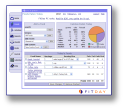
fitday Food diaries like FitDay (I think this is the best out there and the online version is free - will review this soon with tips on how to use it), MyFoodDiary or the online pantry from NutritionData are excellent ways to keep track of your daily consumption trends and help you stay within your requirements. They all offer easy ways to save your favorite foods and even enter nutrition data for foods that are not in their databases.

Updated: Finally it’s important to remember that while this post talks only about your intake of fat, any calories you consume in excess of your daily requirement (on average, about 2000) will be stored as fat too. It’s as equally imperative to keep track of total calorie consumption as it is of individual food-groups like carbs, proteins or fats.

What techniques do you use to track your food consumption? Do you know where you are getting your fat from?

Technorati Tags: health, nutrition, calories, food journal, food diary, fat

Related Posts:


Foods Labeled “All Natural”: How natural are they?

13

December

npr logoDriving home from work yesterday while listening to my favorite show on the radio, NPR’s All Things Considered, I chanced upon a couple of interesting clips that explore the very common use of the word “Natural” in food packages and nutrition labels.

In the segment Meat Firms Give USDA an Earful on ‘Natural’ Label, Allison Aubrey mentions that:

The U.S. Department of Agriculture is considering a new definition of “natural foods,” at least when it comes to meat and poultry. At a public meeting, the agency heard from critics who say that for meat labels, a “natural” claim should only be allowed when meats don’t contain any additives or preservatives.

This is certainly good news for sticklers of natural food products who do not want any kind of preservatives in their meats. For example:

One common technique used by chicken processors is to inject the meat with saline solution. The additive itself is natural. But is it natural to pump it into chicken? Manufacturers like the Sanderson Farms Company, based in Laurel, Miss., and Hormel, makers of the Natural Choice line of deli meats, say it isn’t. And they want their products to stand apart from meats treated with salt or other materials.

When saline solution is injected into the meat, it tends to tenderize and flavor the meat, but also disturbs those who worry about misleading consumers. And thnk about this too: the salt water increases the weight of the chicken (which is usually sold by the pound) and so there’s the other concern that consumers are now paying partially for the weight of the injected salt-water while the label on the package continues to tout “All Natural”!

Some of this is human psychology. Agriculture Department officials noted Tuesday, for instance, that they need better information about what consumers think terms like “natural,” “minimal processing” and “artificial and synthetic” mean. This could shape what practices officials allow for each term.

Federal officials have convened a Dec. 12 public hearing at Agriculture Department headquarters in Washington. That four-hour hearing will just be the appetizer. Next, the Agriculture Department will start formally rewriting the rules.

-Via The Mercury News

What to EatThen there’s the non-meat side of the story. Think about the plethora of common household products like jams, cereal bars and sauces. Do they qualify as natural? NPR talks about that too.
The segment Looking Behind the ‘Natural’ Label on Foods is another thought-provoking discussion between Noah Adams and nutritionist Marion Nestle about what it really means when foods are labeled “natural.” Nestle is the Paulette Goddard Professor of Nutrition, Food Studies, and Public Health at New York University and author of a recent book What to Eat.

To find out for myself, I decided to see for myself what ingredients were used in a leading product that is labeled as being natural.

Nature Valley is one of the largest manufacturers of ready-to-eat bars including trail-mix and granola bars.

nature valley trail mix

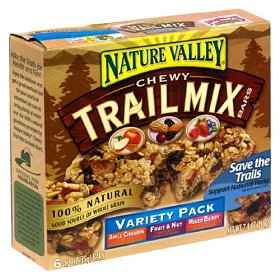
Their Chewy Trail Mix product line consists of popular ready-to-eat bars that proudly bear the following sign on their packaging: “100% Natural, Good Source of Whole Grain”. That alone would be enough to convince most consumers that the bar is an excellent addition to their pantry.

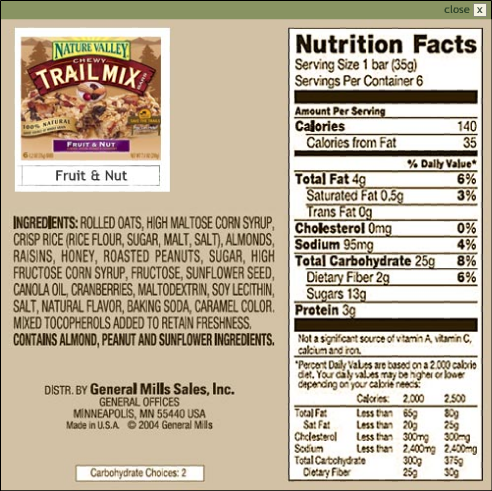
But let’s take a good look at the ingredient list:

nature valley trail mix nutrition value

Two suspects pop right out fo the list: High Maltose Corn Syrup and our arch-nemesis High Fructose Corn Syrup. You already know that High Fructose Corn Syrup (HFCS) is made in industrial vats by running multiple genetically-modified enzymes over (almost always) genetically modified corn-starch, unnaturally extracting glucose and then increasing its fructose content to about 55%. High Maltose Corn Syrup is not too innocent either - it is just a distant cousin of HFCS except it has a higher maltose (rather than fructose) content and is not as sweet. It is still a corn-based, enzymatically produced, unnatural product.

Now enzymes are in use everyday in our body starting from the mouth and all the way down to our intestines - that is how we process food. But should enzymes be used to convert a naturally occuring whole-grain like corn into glucose (and then increasing either its fructose or maltose content) before we ever get a chance to consume it? Can it still be considered “natural” after all this processing? These are important questions the FDA should address so consumers are aware of what constitutes a natural product.

In contrast consider truly natural products like regular oatmeal or natural sweeteners like honey or pure maple syrup. These are almost “directly from nature” products and the only “processing” they undergo is literally chopping the product down to size (in the case of oatmeal) or pouring into convenient jars (for honey/mape syrup) for easy consumption.

The next time you walk into a grocery store and see the words “Natural” on a product, a simple quick peek at the ingredient list will reveal the truth to you. As a discerning consumer you owe this to yourself.

Technorati Tags: health, nutrition, food labels, natural, high fructose corn syrup

Related Posts:


Older Entries Newer Entries

Blogroll
    Design Resources
      Currently Reading:
      "Good Calories, Bad Calories"
      by Gary Taubes
      Good Calories, Bad Calories

      Subscribe to Fitness Mantra       Proud Member of the 9Rules Network


      Recent Comments
      • Keith: I think that there are healthier fiber alternatives. I think it helps to have fiber one cereal with skim milk,...
      • Keith: You should do a review of this book: The Diet Detective's Count Down: 7500 of Your Favorite Food Counts with...
      • Keith: My friends and I recently went to PF Changs to celebrate my birthday. I have been there numerous times - I...
      • toots: I bought a couple boxes because of the fiber content and WOW I hardly ever have gas, and I could not stop!!!...
      • Justin Hartnell: I am doing a research report on HFCS for one of my classes. I have found so many industry supported...


      del.ico.us

      Links To FitnessMantra (Technorati)